

Ahmed Kamel – Egypt Daily News
Russian President Vladimir Putin has directed his top security and defense officials to draw up proposals for a potential resumption of nuclear weapons testing, following comments by U.S. President Donald Trump that appeared to suggest Washington might restart its own atomic tests for the first time in decades.
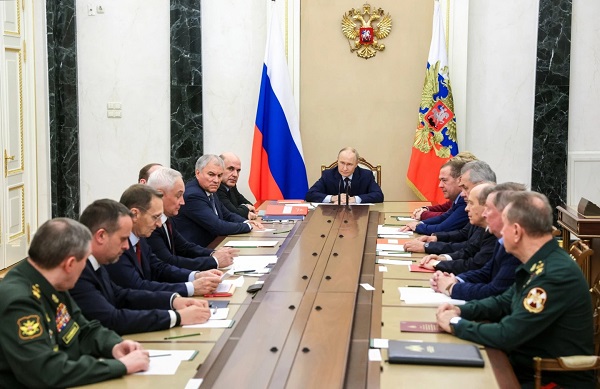
Speaking at a meeting of Russia’s Security Council on Wednesday, Putin reaffirmed that Moscow would only consider resuming such tests if the United States were to take the first step. However, he ordered the Defense Ministry, Foreign Ministry, and other relevant agencies to assess the situation and submit coordinated recommendations on how Russia should respond to what he described as “serious developments.”
“This is indeed a serious issue,” Putin said, adding that Russia must fully understand Washington’s intentions. He confirmed that Russian Ambassador to the United States Alexander Darchiev had been instructed to seek clarification from American officials about Trump’s statements.
The Russian president’s directive came less than a week after Trump appeared to hint that the U.S. could restart nuclear testing “on an equal basis” with Russia and China. While the U.S. has not conducted a nuclear detonation since 1992, Trump’s remarks made during his visit to South Korea suggested that Washington was prepared to reconsider that long-standing moratorium.
U.S. Energy Secretary Chris Wright later clarified that the new tests ordered by Trump would not involve nuclear explosions, saying they were intended to assess the reliability of existing warheads rather than develop new ones.
Still, the remarks triggered alarm in Moscow, which has viewed the U.S. modernization of its nuclear arsenal as a growing strategic threat. Defense Minister Andrei Belousov told Putin that American testing initiatives and Trump’s comments “significantly increase the level of military threats to Russia.”
Belousov suggested that Russia begin immediate preparations to resume nuclear testing on the Novaya Zemlya archipelago in the Arctic, where the Soviet Union last conducted a test in 1990. “The site is ready for the rapid resumption of nuclear explosions,” he said.
Gen. Valery Gerasimov, Chief of the General Staff, backed the proposal, warning that delay could leave Russia unable to respond effectively if Washington moved ahead with its own testing plans. “If we don’t take appropriate measures now, we will miss the opportunity to react promptly to U.S. actions,” Gerasimov cautioned. “It can take months or even years to prepare for nuclear tests, depending on their type.”
Following the discussion, Putin instructed government agencies to “gather additional information, analyze it within the framework of the Security Council, and submit proposals on the possible start of work related to preparations for nuclear weapons tests.”
Kremlin spokesman Dmitry Peskov later clarified that Putin had not ordered the start of nuclear testing preparations, but had instead tasked officials with evaluating whether such steps might become necessary. “We need to fully understand the United States’ intentions before making any decisions,” Peskov told the state news agency TASS.
Dmitry Medvedev, deputy head of the Security Council, echoed that sentiment but warned that Moscow could not afford to ignore Trump’s remarks. “No one knows what Trump meant about ‘nuclear testing’—he probably doesn’t himself,” Medvedev wrote on the social platform X. “But he’s the president of the United States. The consequences of such words are inescapable: Russia will be forced to assess the expediency of conducting full-fledged nuclear tests itself.”
Russia revoked its ratification of the Comprehensive Nuclear Test Ban Treaty (CTBT) in 2023, citing the fact that the United States had signed but never ratified the treaty. The move, Moscow said at the time, was intended to restore “strategic parity” with Washington.
The CTBT, adopted in 1996, bans all nuclear explosions for both civilian and military purposes. Although the U.S. and most other nuclear powers have observed the moratorium in practice, the treaty has never formally entered into force because key states, including the United States and China, have not ratified it. North Korea remains the only country to have conducted nuclear tests in the 21st century.
Putin has repeatedly insisted that Russia continues to observe the treaty’s principles and does not plan to abandon them. But his order this week underscores how quickly the fragile framework of nuclear restraint between Moscow and Washington is eroding amid rising geopolitical tensions.
For now, Russian officials say the directive is primarily an exercise in contingency planning. Yet with both powers modernizing their arsenals and mutual trust at its lowest point since the Cold War, even the discussion of renewed nuclear testing is enough to rekindle fears of a new global arms race.
