

Ahmed Kamel – Egypt Daily News
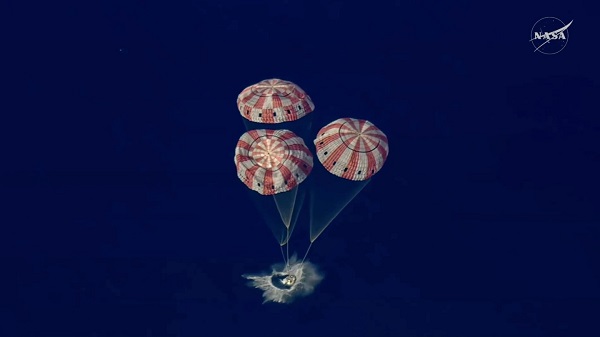
Astronauts aboard Artemis II concluded humanity’s first crewed mission around the Moon in more than 50 years with a dramatic splashdown in the Pacific Ocean on Friday, marking a major milestone in modern space exploration.
The mission ended off the coast of San Diego, where the four astronauts emerged safely from their Orion capsule after a high-speed reentry into Earth’s atmosphere. The spacecraft, named Integrity, completed its descent on autopilot, hitting the atmosphere at speeds reaching Mach 33 before slowing to a controlled splashdown.
Commander Reid Wiseman, pilot Victor Glover, mission specialist Christina Koch, and Canadian astronaut Jeremy Hansen were recovered in a carefully coordinated operation involving military helicopters and U.S. Navy personnel aboard the USS John P. Murtha.
The nearly 10-day mission set new records, including the farthest distance ever traveled by humans from Earth over 252,000 miles, surpassing the benchmark set during Apollo 13. The crew also captured unprecedented views of the Moon’s far side, witnessed a total solar eclipse, and documented striking images of Earth from deep space.
The return marked the fastest lunar reentry since the Apollo era, with the capsule enduring extreme heat and a temporary communications blackout as it passed through Earth’s atmosphere. The successful performance of its heat shield was seen as a critical test for future missions.
NASA officials hailed the mission as a major step toward returning humans to the lunar surface. Administrator Jared Isaacman described the crew as “ambassadors from humanity to the stars,” as mission control erupted in celebration following confirmation of a safe landing.
Artemis II also marked a historic shift in representation. Koch became the first woman to travel to the Moon, Glover the first Black astronaut to make the journey, and Hansen the first non-American astronaut to participate in a lunar mission.
Launched on April 1 from Florida, the mission did not land on the Moon but completed a flyby trajectory, paving the way for more complex operations in upcoming missions. Despite minor technical issues including valve malfunctions and onboard system glitches, the crew reported no major disruptions.
The Artemis program is expected to continue with Artemis III, which aims to land astronauts near the Moon’s south pole, followed by further missions to establish a sustained human presence on the lunar surface.
The success of Artemis II signals a renewed era of lunar exploration, as space agencies prepare for long-term missions and the eventual construction of a permanent Moon base within the coming decade.
