

Ahmed Kamel – Egypt Daily News
The Federal Reserve raised its benchmark interest rate by 25 basis points on Wednesday, lifting the target range to between 3.75% and 4%. The decision marked the first increase since July 2023 and followed five consecutive meetings in which policymakers left rates unchanged.
The Federal Open Market Committee approved the increase unanimously. In its latest statement, the committee said inflation remained elevated and indicated that the policy action was intended to support a faster return of inflation to its 2% target.
The wording represented a more forceful position than the language used in the committee’s July statement. In July, policymakers said inflation remained high relative to the central bank’s target and attributed part of the pressure to supply shocks affecting areas such as energy. The September statement removed that reference and instead directly connected the interest-rate increase with the goal of returning inflation to 2% more quickly.
The decision came as policymakers assessed a combination of persistent inflation, resilient domestic spending and a labor market that remained broadly stable. The Federal Reserve said economic activity was expanding at a solid pace and noted that domestic spending had remained resilient. It also described productivity growth as strong and characterized capital investment as solid.
The committee maintained its assessment that uncertainty surrounding the economic outlook remained elevated, partly because of geopolitical developments. However, the statement did not indicate that those risks had prevented policymakers from prioritizing price stability.
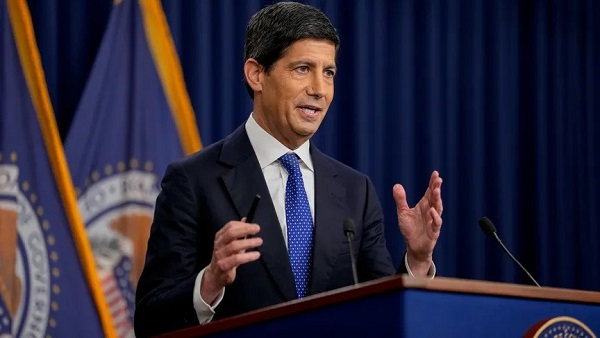
Federal Reserve Chair Kevin Warsh said during a news conference that price stability was the central bank’s main focus. He described inflation in the United States as too high and said it had remained at that level for too long. He also said the labor market was in good condition, while inflation risks were tilted to the upside and employment risks appeared balanced.
Warsh said recent inflation readings had not shown a significant improvement in underlying price trends. He added that the Federal Reserve wanted to prevent price increases from spreading more broadly across the economy. According to his remarks, several categories of goods were still recording annual price increases above 3%.
The chair characterized the rate increase as evidence that the Federal Reserve was serious about containing inflation. His comments placed greater emphasis on the need to prevent elevated price growth from becoming entrenched, even as economic activity continued to expand.
The decision also carried political significance. President Donald Trump has repeatedly called for lower interest rates and has argued that borrowing costs in the United States should be among the lowest in the world. Warsh declined to discuss conversations with Trump during the news conference.
The White House described the rate increase as unfortunate to some extent. A White House spokesperson also said that Trump continued to support the independence of the Federal Reserve. The administration added that higher interest rates would not change oil prices.
The Federal Reserve’s updated projections pointed to another increase before the end of 2026. The median projection for the federal funds rate at the end of that year rose to 4.1%, compared with 3.8% in the June projections. Because the target range now stands at 3.75% to 4%, the new median implies an additional quarter-point increase during the remainder of 2026.
The projections showed that 16 of the 18 officials expected at least one additional increase by the end of 2026. Four officials anticipated two further increases. The projections also indicated that policymakers did not expect to lower interest rates during the following year.
Officials raised their median forecast for core inflation to 3.4% in 2026 and projected a decline to 2.5% the following year. The median unemployment-rate projection remained at 4.1% for both the current year and the next year.
Financial markets reacted negatively after the decision and Warsh’s comments. U.S. stocks gave up earlier gains, while short-term Treasury securities weakened. The yield on the two-year Treasury note rose by six basis points to 4.73%, and the dollar strengthened.
The market reaction reflected the possibility that interest rates could remain higher for longer than investors had expected. A further increase would raise borrowing costs for households, businesses and financial institutions, while potentially increasing returns on some savings products and short-term government securities.
The unanimous vote also contrasted with the committee’s previous meeting. At the July meeting, nine officials supported keeping rates unchanged, while three preferred a quarter-point increase. The latest decision indicated that the members who had favored waiting in July had joined the majority in supporting tighter policy.
By raising rates while maintaining that economic activity was strong, the Federal Reserve signaled that it currently considers inflation the more pressing risk. Its updated projections suggested that policymakers expect price pressures to remain above target through 2026, even if inflation gradually declines afterward.
