

Ahmed Kamel – Egypt Daily News
Foreign ministers of Egypt, Pakistan, Saudi Arabia, and Turkey have welcomed the recently signed Islamabad Memorandum of Understanding (MoU) between the United States and Iran, describing it as a significant step toward reducing tensions and preventing a wider regional conflict.
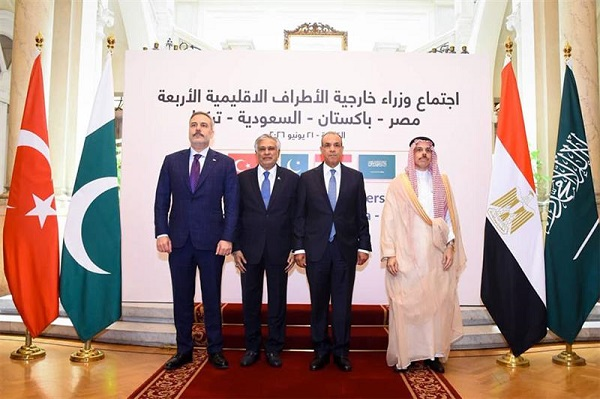
A joint statement issued following the fourth consultative meeting of the R4 group in Cairo on June 21, the ministers praised the agreement as a constructive breakthrough that could help restore stability to a shaken region by months of fighting and destruction.
Hosted by Egypt, the meeting brought together senior diplomats from the four countries to discuss key regional and international developments, with particular attention focused on the implications of the US-Iran understanding and broader Middle East security challenges.
Support for De-escalation Efforts
The ministers said the memorandum, signed in Islamabad on June 18, represents an important milestone in efforts to end a conflict that had threatened regional security, global energy markets, international shipping routes, and supply chains.
They welcomed the diplomatic efforts that led to the agreement and emphasized the need for all parties to fully implement their commitments in order to preserve the momentum generated by the deal.
The statement highlighted the role played by regional mediators in facilitating the breakthrough, with particular praise directed toward Pakistan for its diplomatic engagement throughout the process. Qatar was also recognized for its support in helping bring negotiations to a successful conclusion.
According to the ministers, continued regional cooperation remains essential to transforming the memorandum into a lasting framework for stability and conflict prevention.
Call for Next-Phase Negotiations
While welcoming the agreement, the four countries stressed that substantial work remains to be done.
The ministers urged all parties to move quickly toward the next phase of negotiations aimed at resolving outstanding issues and establishing a durable, verifiable, and mutually acceptable settlement. They emphasized that future discussions must address the concerns of countries across the region, particularly those related to the security and stability of Gulf Arab states and the Levant.
According to the joint statement, a comprehensive approach that considers regional interests will strengthen collective security arrangements and help create the conditions for long-term peace and stability.
The ministers also reaffirmed the importance of sustained dialogue and coordination among their countries, describing consultation as a critical tool for managing regional crises and preventing future escalations.
Palestinian Issue Remains Central
Beyond the US-Iran agreement, the ministers reiterated their shared position that the Palestinian issue remains central to achieving lasting peace and stability in the Middle East.
The joint statement described the Palestinian cause as a cornerstone of efforts to build a secure and stable regional order and emphasized the need for a just and comprehensive resolution in accordance with international law and relevant United Nations resolutions.
The ministers expressed particular concern about the humanitarian and political situation in Gaza, the occupied West Bank, and East Jerusalem.
They reaffirmed support for the Palestinian people’s right to self-determination and reiterated backing for the establishment of an independent Palestinian state based on the June 4, 1967 borders, with East Jerusalem serving as its capital.
Egypt Expands Regional Diplomatic Role
The Cairo meeting comes amid intensified Egyptian diplomatic activity aimed at supporting regional de-escalation and building on the momentum generated by the US-Iran memorandum.
Egyptian officials have described the agreement as a potential turning point that could reduce tensions across multiple conflict zones and create opportunities for broader diplomatic engagement. The R4 mechanism, which brings together Egypt, Saudi Arabia, Pakistan, and Turkey, has increasingly emerged as an influential platform for coordinating regional positions on security, diplomacy, and conflict resolution.
Ahead of the ministerial meeting, Egyptian President Abdel Fattah El-Sisi called for the four-country framework to evolve into a more effective institutional mechanism capable of responding to regional crises and addressing emerging security challenges.
According to the Egyptian presidency, El-Sisi argued that recent developments have underscored the strategic importance of Egypt, Saudi Arabia, Pakistan, and Turkey as key pillars of regional stability.
Broader Regional Consultations Continue
The Cairo gathering followed a series of high-level consultations conducted by Egypt on regional security issues.
One day before the R4 meeting, Egyptian Foreign Minister Badr Abdelatty held discussions in Cairo with his Saudi and Turkish counterparts, as well as Massad Boulos, senior adviser to the US president for Arab and African affairs. Those talks focused on the implementation of the US-Iran memorandum, developments in Gaza, the situation in Libya, and broader security concerns across Africa and the Middle East.
As regional powers seek to capitalize on the diplomatic opening created by the Islamabad agreement, attention is now shifting toward the next round of negotiations, which many policymakers view as critical to determining whether the current momentum can be translated into a lasting framework for regional peace and stability. However the Middle East has taught us never to expect the expected.
