

Ahmed Kamel – Egypt Daily News
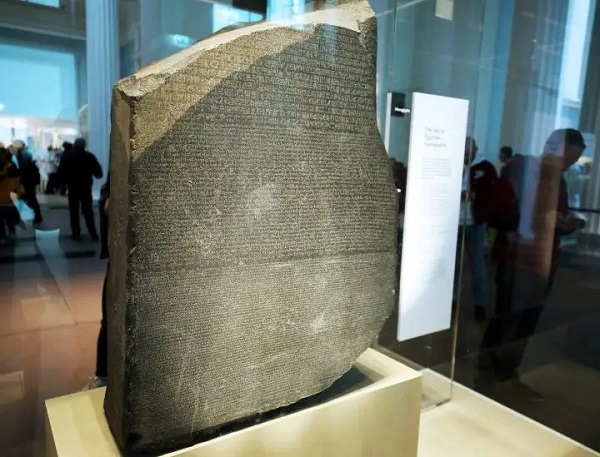
Egypt has revived demands for the return of the Rosetta Stone from the United Kingdom, even as officials take a more conciliatory tone toward the tens of thousands of other Egyptian artefacts housed in British institutions. The renewed appeal comes amid the long-awaited opening of the Grand Egyptian Museum, a milestone that has renewed public debate over cultural heritage and historical ownership.
The Rosetta Stone, however, remains a unique and contentious case. Mohamed Ismail Khaled, secretary general of Egypt’s Supreme Council of Antiquities, asserted that the 196 BC granodiorite slab was taken illegally during wartime and should be returned to its country of origin. “Of course we would love it to be returned because Egyptians have never seen it,” he said. “Generations read about it and know about it but they have never seen it. There are lots of voices in Egypt thinking we should argue for its return as it is their right.”
The British Museum strongly disputes any claim of illegality, pointing to the 1801 Treaty of Alexandria, negotiated following the defeat of French forces in Egypt. The treaty, signed by British commanders and an admiral of the Ottoman Empire, which then ruled Egypt required that French scholars and officers surrender several antiquities, including the Rosetta Stone. After arriving in Portsmouth in 1802, the inscription became an object of major scholarly interest. The trilingual text carved on its surface later enabled the decipherment of ancient Egyptian hieroglyphs in 1822, making it one of the most significant archaeological discoveries in modern history.
The stone’s removal has long been a flashpoint in debates about colonial-era acquisitions. Egypt’s calls for repatriation have recurred periodically, flaring most recently in 2022 when two major petitions, one organised by a former Egyptian minister and another by prominent Egyptologist Monica Hanna, increased public pressure on British authorities. Hanna argued that the British Museum’s possession of the stone symbolised “Western cultural violence against Egypt.” Although museum officials in Cairo suggested in 2018 that discussions were underway for the stone’s return, the Egyptian government has yet to submit a formal repatriation request.
The opening of the Grand Egyptian Museum, a project decades in the making has added new urgency to Egypt’s broader campaign to reclaim artefacts it believes were removed unlawfully. In recent years, the country has successfully lobbied for the return of several objects from European institutions. Most recently, the Netherlands agreed to repatriate a 3,500-year-old sculpted head from the reign of Thutmose III after provenance concerns were raised.
For now, Egypt appears to be distinguishing between artefacts removed through documented 19th- and early-20th-century exchanges and those it argues were taken under coercive or irregular circumstances. While thousands of Egypt’s ancient treasures remain central attractions in British museums, Cairo’s renewed focus on the Rosetta Stone underscores its determination to reclaim what it views as the most emblematic symbol of its cultural heritage.
