

Ahmed Kamel – Egypt Daily News
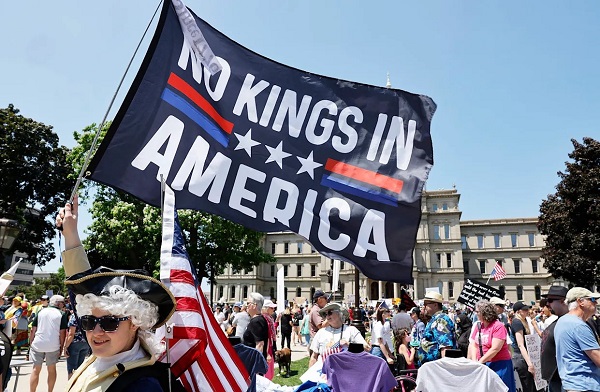
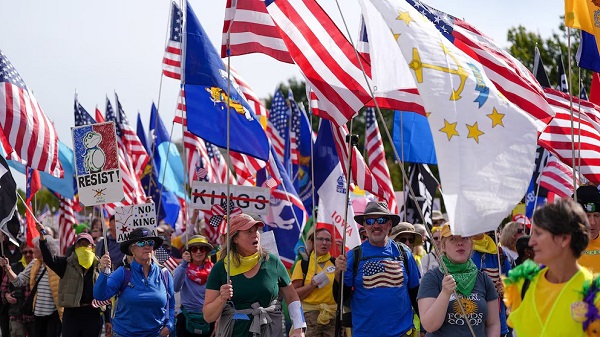
On Saturday, tens of thousands of demonstrators took to the streets across the United States in a coordinated day of action under the banner “No Kings,” aimed at protesting what organizers call the authoritarian tendencies of former President Donald Trump and his allies.
The protests, organized by a coalition of advocacy groups including the ACLU, Indivisible, and others, spanned more than 2,600 cities and towns making it one of the largest mass mobilizations since June. Organizers cited issues such as immigration raids, the deployment of federal troops in American cities, and what they described as the undermining of democratic institutions as reasons for the mobilization.
“We’re out here for immigrant families under attack, for voters being silenced, for communities overpoliced and underrepresented,” said Deirdre Schifeling, chief political and advocacy officer at the ACLU. “This is about defending the basic principle that America doesn’t have kings.”
A Protest Movement Rooted in Grassroots Organizing
The “No Kings” campaign has grown out of smaller, decentralized efforts into a broad national network, with backing from both grassroots volunteers and major advocacy organizations. According to the Progressive Change Campaign Committee, celebrities including Jane Fonda, Kerry Washington, John Legend, and John Leguizamo participated in various events to help draw attention to the cause.
Some groups, such as Home of the Brave, spent heavily to amplify the movement, pouring over $1 million into national and local advertisements ahead of the rallies.
Despite the scale and visibility of the protests, organizers maintain that the effort is largely people-powered. “These were organized by regular people, by volunteers,” said Schifeling. “That’s what makes them so powerful.”
A Polarizing Response from the Right
Republican leaders responded sharply in the days leading up to the protests, branding the demonstrations as anti-American and politically motivated. Senate Majority Leader John Thune accused Democrats of using the protests to energize their base while delaying negotiations to end the ongoing federal government shutdown.
“The truth is what Democrats really want is something Republicans can’t give them. And that is the approval of their far-left base,” Thune said.
House Speaker Mike Johnson went further, calling the event a “Hate America Rally” and warning that participants could include what he described as “Marxists, Antifa types, and pro-Hamas supporters.” Johnson provided no evidence to support those claims.
His rhetoric was met with sharp criticism from Democratic lawmakers and protest organizers. State Rep. Gene Wu of Texas, responding to the state’s decision to deploy the National Guard to Austin ahead of the rallies, wrote on X, “Sending armed soldiers to suppress peaceful protests is what kings and dictators do—and Greg Abbott just proved he’s one of them.”
Law Enforcement and Security Concerns
With events of this scale, law enforcement agencies remained on alert. Police departments in major cities worked with organizers and monitored online activity for potential threats, especially given recent tensions around political gatherings.
Texas Governor Greg Abbott announced on Thursday he had ordered a “surge” of Department of Public Safety officers and National Guard troops into Austin to prevent what he called “chaos.” Organizers criticized the move as an intimidation tactic.
Still, events remained largely peaceful, according to early reports, with demonstrators marching, chanting, and holding signs echoing the rally’s central message: that no person regardless of political office, should be above democratic accountability.
Trump Responds: “I’m Not a King”
In a taped interview with Fox News’ Maria Bartiromo ahead of the protests, Trump dismissed the rallies as misdirected. “They’re referring to me as a king. I’m not a king,” he said.
Trump’s critics, however, point to what they view as an increasingly unilateral approach to governance—ranging from efforts to override immigration policies to sending federal troops into U.S. cities as justification for the “No Kings” label.
Shutdown Politics and Public Opinion
The protests come amid a prolonged federal government shutdown, now entering its third week. While Republican leaders have accused Democrats of stalling to capitalize on the momentum from the rallies, polls show Americans largely split over which party is to blame.
Leah Greenberg, co-executive director of Indivisible, pushed back on Republican attacks, arguing that the movement’s core message is distinctly American.
“It’s telling that some leaders refuse to even say the name of the protest,” Greenberg said. “Because if you say ‘No Kings,’ the argument falls apart. There is nothing more American than rejecting kings and standing up for democracy.”
She and other organizers believe the backlash may in fact drive greater turnout and deepen public engagement. “Americans see through these distractions,” said Schifeling. “They know who’s working to protect their rights and who’s trying to take them away.”
What Comes Next?
With massive turnout and growing political visibility, organizers say this weekend’s protests are just one step in a longer campaign to resist what they see as authoritarian drift. Plans are already underway for additional mobilizations leading up to the 2026 midterm elections, with activists hoping to keep pressure on lawmakers across the political spectrum.
“This isn’t just about one person or one party,” said Ezra Levin, co-executive director of Indivisible. “It’s about the kind of country we want to be. No kings, no dictators just a government that listens to the people.”
