

Ahmed Kamel – Egypt Daily News
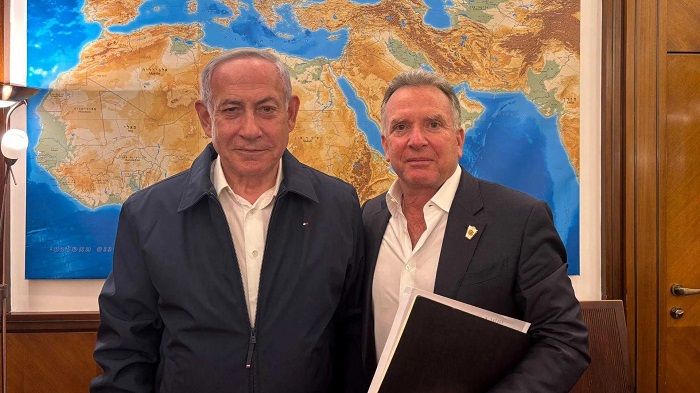
In a critical diplomatic effort to de-escalate the ongoing conflict in Gaza, U.S. Special Envoy Steve Witkoff met with Israeli Prime Minister Benjamin Netanyahu on Thursday. The talks aim to revive stalled ceasefire negotiations and address the worsening humanitarian situation in the Palestinian territory, where an international hunger monitoring organization has warned of an impending famine.
Witkoff’s arrival in Israel came amid mounting international pressure on the Israeli government over the extensive destruction in Gaza and severe restrictions on humanitarian aid. Hours before his meeting with Netanyahu, U.S. President Donald Trump posted on his Truth Social platform, emphasizing that the quickest resolution to Gaza’s crisis would be “Hamas’s surrender and the release of hostages.”
In a notable shift in U.S. policy, the State Department announced sanctions against officials from the Palestinian Authority and the Palestine Liberation Organization (PLO), accusing them of undermining peace efforts. This move distances Washington from some European allies who have recently expressed openness to recognizing a Palestinian state. France, Britain, and Canada have signaled possible imminent recognition, backing the two-state solution supported by the Palestinian leadership — which contrasts with the Hamas-controlled Gaza Strip.
The U.S. sanctions will restrict travel to America for targeted individuals, although their identities have not been publicly disclosed. The Palestinian Authority has yet to comment on the measures.
Meanwhile, Israeli Defense Minister Yisrael Katz and Justice Minister Yariv Levin expressed support for the annexation of the West Bank, a move that Palestinians say would extinguish any prospects for a future independent Palestinian state and undermine peace negotiations. “At this very moment, there is an opportunity that must not be missed,” the ministers stated, highlighting their government’s intent to solidify control over disputed territories.
The indirect ceasefire talks between Israel and Hamas, held in Doha last week, reached an impasse, with both sides blaming each other for the stalemate. Key disagreements remain over Israeli troop withdrawals and conditions for a long-term truce. Israel responded on Wednesday to Hamas’s latest amendments to a U.S.-proposed deal that would see a 60-day ceasefire and hostage releases in exchange for Palestinian prisoners. Hamas has not publicly commented.
On the ground in Gaza, the situation remains dire. Medical officials report that at least 23 people were killed by Israeli fire on Thursday alone, including a dozen gathered near the Nitzanim crossing point—a zone controlled by Israeli forces in central Gaza—where they were seeking aid. The Israeli military stated its troops fired warning shots to disperse crowds posing a threat, denying any fatalities.
Since the conflict began, the Gaza Health Ministry has documented 154 deaths caused by hunger and malnutrition, most occurring in recent weeks and including at least 90 children. The United Nations has accused Israeli forces of killing more than a thousand Palestinians since late May as they attempted to access humanitarian assistance.
The Israeli public broadcaster Kan reported that Witkoff is scheduled to visit an aid distribution center in Gaza as part of his mission.
In response to international outrage over images of starving children, Israel announced a temporary daily ceasefire of ten hours in certain Gaza areas, allowing humanitarian convoys to deliver food and medicine along designated safe routes.
Despite these gestures, United Nations officials caution that aid volumes remain grossly inadequate. UN humanitarian coordinator for Gaza noted that while more supplies entered the enclave during brief pauses in fighting, many Palestinians continue to face deadly risks from both Israeli military operations and armed gangs when attempting to reach relief resources.
A local resident from Deir al-Balah described repeated failed attempts to collect essential supplies, recounting an incident in which he was threatened at knife-point by thieves seeking to seize aid.
As the death toll in Gaza surpasses 60,000 over nearly two years of intermittent conflict, pressure mounts on Hamas to negotiate a ceasefire. Yet, Hamas continues to hold 50 hostages, with estimates that 20 remain alive. Families of captives have organized protests demanding an end to the war, including demonstrations outside Netanyahu’s office.
Netanyahu, whose coalition includes parties advocating for a permanent Israeli presence and Jewish settlements in Gaza, insists the conflict will continue until Hamas relinquishes control of the territory and disarms. Hamas rejects calls to surrender its weapons.
In parallel diplomatic efforts, Qatar and Egypt, mediators in ceasefire negotiations, endorsed a joint statement by France and Saudi Arabia outlining steps toward a two-state resolution. The declaration urges Hamas to end its governance in Gaza and transfer its arsenal to the Palestinian Authority.
Israel has vocally condemned European countries’ recent moves toward Palestinian state recognition, viewing such gestures as rewards to Hamas following the October 7, 2023, attacks that sparked the current war. That assault resulted in over 1,200 Israeli deaths and the abduction of 251 hostages, fueling ongoing hostilities.
German Foreign Minister Johannes Faßbender, who traveled to Israel amid the crisis, stressed the necessity of renewed peace talks focused on a two-state solution, while clarifying that any German recognition of a Palestinian state would only occur after the diplomatic process concludes.
As the conflict grinds on with devastating humanitarian consequences, the international community watches closely, hoping diplomatic interventions might finally lead to a sustainable peace and relief for the people of Gaza.
