

Ahmed Kamel – Egypt Daily News
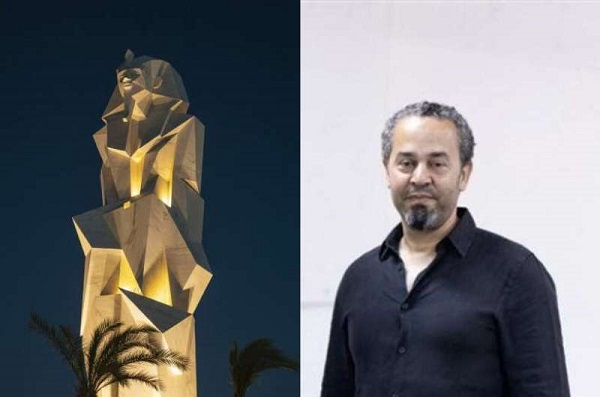
A striking new sculpture near the entrance of the Grand Egyptian Museum is generating widespread attention, both for its bold contemporary design and for its deep ties to Egypt’s ancient heritage. The towering artwork, which has sparked lively discussion on social media, was created by Dr. Diaa Awad, professor of sculpture at the Faculty of Fine Arts at Minya University, and is intended to symbolize a modern reimagining of Egypt’s identity, rooted firmly in its pharaonic past.
Dr. Awad revealed the conceptual and technical details behind the piece, which was developed under the supervision of the Egyptian Cabinet and the Giza Governorate, with professional consultants involved from the project’s earliest stages.
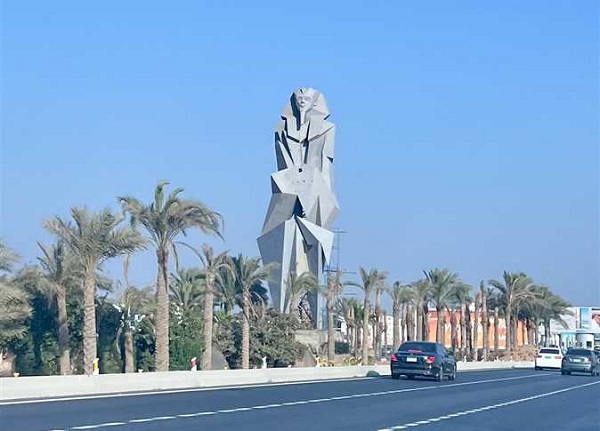
The sculpture, which stands 27 meters high, is part of the artistic framework surrounding the planned opening of the Grand Egyptian Museum, scheduled for November. Strategically placed near the Cairo–Alexandria Desert Road and the museum’s entrance gates, the statue is designed to serve as a landmark — a powerful visual signal of entry into a space defined by Egypt’s ancient grandeur and modern cultural ambition.
Dr. Awad explained that the work draws its aesthetic and structural inspiration from Egypt’s iconic pyramids. The base of the statue incorporates a series of geometric triangles, a direct homage to the architectural motif of the pyramids as well as to the design language of the museum itself, which extensively uses triangular forms in its architecture.
“The sculpture is a cohesive composition that rises from the roots of the earth,” Awad said. “It culminates in a stylized representation of an ancient Egyptian figure wearing the royal nemes headdress, the sacred cobra (uraeus), and the traditional false beard. The entire form follows a geometric, experimental style that avoids distorting the classical pharaonic features.”
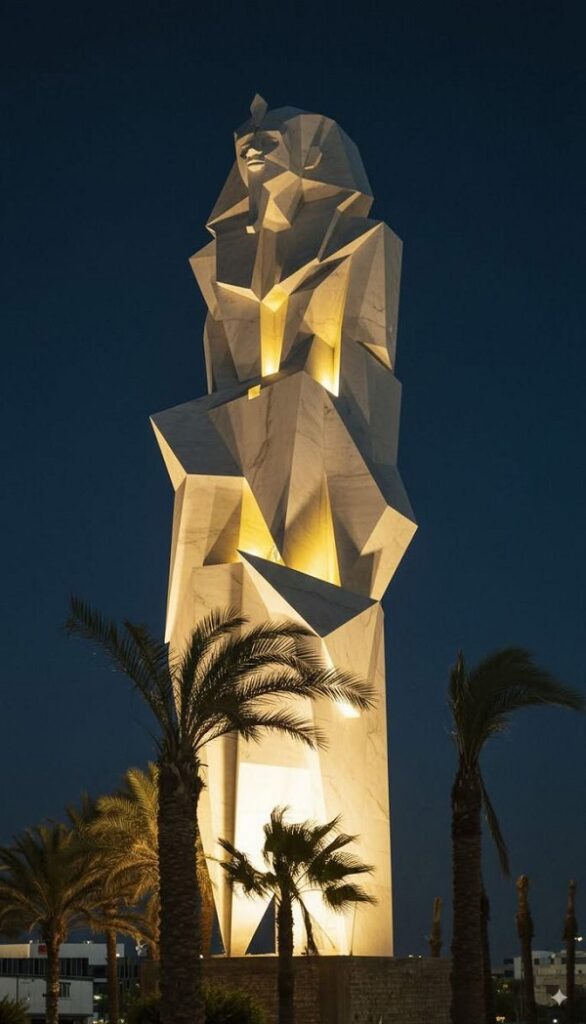
Notably, the figure is not meant to represent any specific historical person, it is an abstract symbol of Egyptian identity, not a replica of a particular pharaoh such as Ramses II. “This is not a comparison with any known statue,” Awad clarified. “Rather, it is a contemporary homage to the timeless visual language of Egyptian civilization.”
Awad emphasized that the statue is intended to connect symbolically with Egypt’s archaeological landscape, including the pyramids of Giza, Dahshur, Saqqara, and other key heritage sites. “There is a strong dialogue between this sculpture, the architecture of the Grand Egyptian Museum, and the surrounding historical context,” he said. “Anyone who sees it whether Egyptian or foreign will immediately know they are in Egypt. That clarity of cultural identity was essential to the concept.”
The unveiling of the statue has triggered significant online debate, with opinions ranging from high praise to critical scrutiny a reaction Awad said he fully anticipated. “There’s no statue like it in the Middle East in terms of scale and visual style,” he said. “Its placement near one of Egypt’s most important cultural projects and on a key roadway guaranteed it would draw attention. Public art invites both praise and critique that’s the nature of visual dialogue in society.”
Still, the artist expressed gratitude for the positive feedback he has received, especially from art professionals and heritage enthusiasts. He noted that this is not his first work to serve as a “landmark” in the area, several other sculptural installations around the museum entrance and Al-Ramaya Square are also his creations.
For Dr. Awad, the sculpture represents more than a visual tribute to Egypt’s past, it is a call to reimagine cultural heritage through a modern lens. “It’s about reviving the idea of legacy in a contemporary form,” he said. “We’re not copying the past; we’re building on it grounding it in the present while reaching toward the future.”
