

Ahmed Kamel – Egypt Daily News
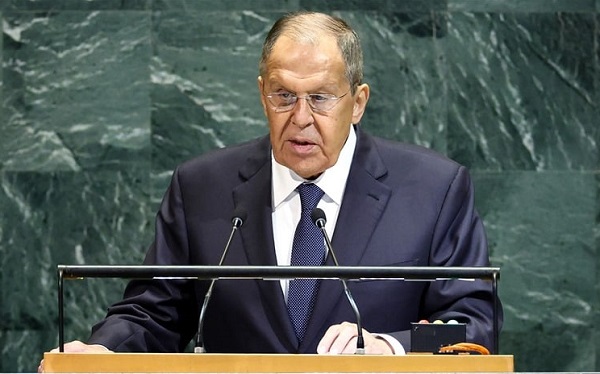
Russian Foreign Minister Sergey Lavrov delivered a strongly worded speech at the United Nations General Assembly on Saturday, accusing Israel of seeking to ignite a full-scale crisis across the Middle East through what he described as unlawful and aggressive actions against several regional actors.
“Israel’s unlawful use of force against Palestinians, and its aggressive moves against Iran, Qatar, Yemen, Lebanon, Syria, and Iraq, are pushing the entire region toward explosion,” Lavrov stated during his address to the 80th session of the UN General Assembly in New York.
Lavrov also rejected Israel’s ongoing policies in the occupied Palestinian territories, particularly its continued annexation of land in the West Bank, which he described as unacceptable under international law.
In his remarks, the Russian foreign minister also criticized Western governments particularly the United States and its allies for what he called efforts to undermine diplomatic processes in the region. He pointed to recent moves to reinstate sanctions on Iran, specifically regarding its nuclear program, as evidence of a deliberate attempt to sabotage negotiations.
Lavrov noted that the UN Security Council had recently rejected a joint resolution by Russia and China that aimed to delay the reactivation of sanctions on Iran. He condemned the rejection as an example of Western “blackmail” and accused Western powers of “deliberately obstructing constructive solutions.”
Turning to growing tensions between Russia and NATO, Lavrov responded sharply to recent remarks by former U.S. President Donald Trump, who reportedly suggested that NATO forces should shoot down Russian aircraft violating alliance airspace.
“Russia has never had, and does not have, any intention to attack NATO or the European Union,” Lavrov said. “However, any act of aggression against our country will be met with a decisive response.”
Lavrov’s speech reflects Russia’s increasingly confrontational posture on the global stage and its attempt to position itself as a counterbalance to what it sees as Western overreach and hypocrisy in international affairs. His remarks also underscore Moscow’s support for regional powers facing Western or Israeli pressure, particularly Iran.
The Russian foreign minister’s warnings add further weight to the growing sense of global instability, as conflicts in the Middle East and Eastern Europe continue to escalate, with few signs of meaningful diplomatic breakthroughs.
