

Ahmed Kamel – Egypt Daily News
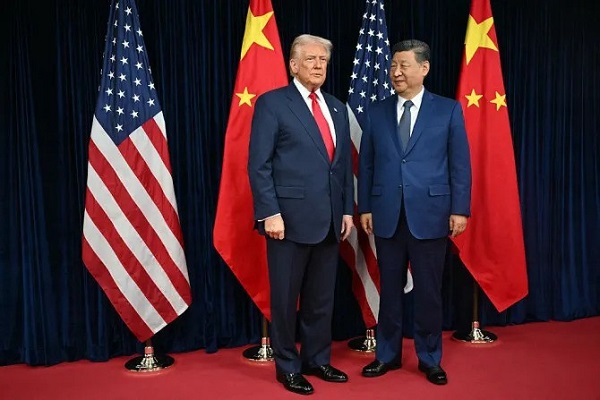
In a surprise diplomatic breakthrough, U.S. President Donald Trump and Chinese President Xi Jinping have agreed to a one-year trade truce, signaling a rare moment of détente in an economic rivalry that has defined global markets for nearly a decade.
The agreement reached during the two leaders’ first face-to-face meeting in six years, on the sidelines of the APEC Summit in South Korea aims to de-escalate one of the most consequential trade disputes of the 21st century.
“This was an amazing meeting,” Trump told reporters afterward. “Both sides took big steps toward fairness.” Chinese state media echoed a similar tone, with Xi saying the two nations had chosen “cooperation over confrontation.”
Tariff Cuts and Key Concessions
According to officials familiar with the negotiations, the deal includes several mutual concessions designed to ease trade friction and stabilize global supply chains. The United States will lower tariffs on a range of Chinese goods, reducing the average rate from roughly 57 percent to 47 percent.
In return, China agreed to intensify efforts to curb the export of illicit fentanyl and its precursor chemicals a major U.S. domestic priority. Duties on fentanyl-related imports will be halved, from 20 percent to 10 percent.
Beijing also pledged to resume large-scale purchases of American soybeans, a critical political win for Trump among U.S. farmers. In another key concession, China will suspend export controls on rare earth elements and critical minerals resources vital to high-tech manufacturing and clean energy industries for one year.
A Pause in a Long Trade War
The temporary truce brings a pause to an economic conflict that has spanned administrations and rattled global markets. Since the first tariffs were imposed in 2018, both nations have exchanged hundreds of billions of dollars in duties, sanctions, and export bans, reshaping global supply chains and accelerating economic “decoupling.”
Economists say the truce could help steady inflation and ease investor uncertainty, even if only temporarily. “This move reduces immediate volatility but does not end strategic rivalry,” said a senior market analyst quoted by The Business Standard.
For Washington, the pause offers political breathing space and potential economic relief ahead of the 2026 midterm elections. For Beijing, it offers time to shore up domestic growth amid real estate turmoil and slowing exports.
Unresolved Issues Loom
Despite the positive tone, experts caution that the truce is far from a comprehensive settlement. Major points of contention including technology transfer, semiconductor export restrictions, and state-subsidy policies remain unresolved.
“This is a ceasefire, not a peace treaty,” said one senior trade expert in Washington. “Both sides have agreed to stop shooting for a year, but the fundamental disagreements are untouched.”
According to Al Jazeera, both leaders view the truce as a reset rather than a resolution. Plans are already in motion for Trump to visit Beijing next April, with Xi expected to make a reciprocal visit to Washington later in 2026. Forbes reported that the framework leaves room for deeper cooperation or renewed confrontation depending on progress in the coming months.
Market Reaction and Political Framing
Global markets responded cautiously but positively. Asian equities rose modestly, while commodity prices steadied after weeks of volatility. The White House hailed the agreement as proof that “tough negotiating works,” emphasizing Trump’s role in securing Chinese commitments on fentanyl.
In Beijing, state media credited Xi with “restoring balance to global trade” and portrayed the truce as a reaffirmation of China’s international leadership amid U.S. protectionism.
Still, skepticism lingers. Export controls on advanced semiconductors remain untouched, and enforcement of China’s promises on agricultural imports and rare earth exports will be closely watched. “This looks more like a one-year pause than a lasting peace,” one observer wrote on Reddit echoing the sentiment of many global analysts.
A Fragile Window for Diplomacy
The Trump–Xi accord offers both powers a chance to recalibrate after years of economic brinkmanship. Yet whether this brief window leads to lasting stability or merely delays another escalation remains uncertain.
As one senior diplomat in Seoul remarked: “They’ve bought themselves a year. What they do with it will shape the world economy for the next decade.”
