

Ahmed Kamel – Egypt Daily News
For months, whispers of a grand redevelopment plan for Gaza have circulated among Washington insiders, Israeli financiers, and Gulf investors. Now, recently leaked documents and televised admissions by U.S. officials have exposed the outlines of what critics call a premeditated scheme to seize and remake the Palestinian territory long before Israel’s devastating assault reduced it to rubble.
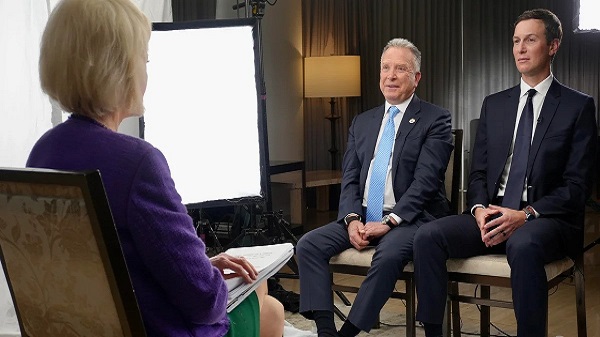
In an interview broadcast on CBS’s 60 Minutes, U.S. Middle East Special Envoy Steve Witkoff revealed that a “master plan” for Gaza’s reconstruction costing an estimated $50 billion had already been drawn up. The plan, he said, would be implemented through a “transparent, regionally backed” process supported by Arab and international partners once a ceasefire takes hold.
“I think it’s going to cost a lot of money,” Witkoff said. “The estimates are in the $50 billion range. It might be a little less, it might be a little more. But that’s not a lot of money in that region. You have governments that are going to jump on in.”
Witkoff described a “Board of Peace” that would manage reconstruction contracts with the help of Middle Eastern and European donors. The board, he insisted, would guarantee transparency and efficiency. Yet critics note that this language mirrors earlier U.S. and Israeli proposals that sought to reframe occupation and dispossession as “development.”
Joining Witkoff in the interview was Jared Kushner, former presidential adviser and Donald Trump’s son-in-law, who declared that Gaza’s future lay in “transparent, good government.” Kushner, who returned to his family’s real estate business after his White House tenure, said the goal was to ensure that “you can’t replace a corrupt government with another corrupt government.”
The interview, described by observers as part self-promotion and part policy trial balloon, aired just as new leaks suggested that Washington had been working on Gaza’s postwar reconstruction plan since at least two years ago well before the Israeli assault that flattened much of the enclave.
The “Great” Plan
According to documents obtained by The Washington Post, the reconstruction blueprint—titled the Gaza Reconstitution, Economic Acceleration and Transformation Trust (abbreviated as Great) envisions a wholesale transformation of the territory. The proposal, reportedly drafted by Israeli and American consultants with input from the Boston Consulting Group, outlines a decade-long U.S. trusteeship over Gaza.
Most explosively, the plan calls for the “temporary relocation” of all two million Palestinians living in the Strip, a euphemism widely interpreted as ethnic cleansing. Displaced families would receive “digital tokens” representing property rights, to be used to finance resettlement elsewhere, while those remaining in Gaza would be confined to micro-apartments as small as 323 square feet.
Human rights groups reacted with alarm. Philip Grant, executive director of Trial International, called the proposal “a blueprint for mass deportation marketed as development.” He warned that corporations or governments participating in such a scheme could face legal exposure under international law for aiding or abetting crimes against humanity.
Trial International is one of fifteen organizations that have previously cautioned Western firms working in Gaza against complicity in war crimes. “Those involved in the planning and execution of such a plan, corporate actors included could face legal liability for decades to come,” Grant said.
“A Trumpian Get-Rich-Quick Scheme”
Even Israeli commentators expressed disbelief. A columnist in Haaretz dismissed the plan as “a Trumpian get-rich-quick scheme reliant on war crimes, AI and tourism.” The proposal, subtitled From a Demolished Iranian Proxy to a Prosperous Abrahamic Ally, imagines Gaza reborn as a futuristic coastal hub of high-tech megacities, a “Gaza Riviera” meant to rival Dubai or Saudi Arabia’s troubled Neom project.
The fantastical design includes an “Elon Musk Manufacturing Park” and a sprawling port city intersected by artificial waterways. Satellite imagery attached to the proposal indicates the annexation of large portions of Gaza’s agricultural land for an Israeli “security buffer zone.” The plan also makes no reference to Palestinian sovereignty, referring instead to a “Palestinian polity” that would operate under Israeli “overarching rights” and join the Trump-era Abraham Accords.
“The small print is the most damning,” said one European diplomat familiar with the document. “It erases Palestinian nationhood entirely and assumes that Gaza can be engineered into a compliant economic zone under permanent Israeli control.”
According to The Post, Boston Consulting Group has since distanced itself from the project, saying that two senior partners involved in the financial planning were terminated.
Planning Before the Destruction
While the 60 Minutes interview portrayed the reconstruction plan as a humanitarian initiative, Witkoff’s comments inadvertently suggested that Kushner and others had been developing it long before Israel’s campaign destroyed Gaza. Critics argue that this timeline raises grave questions: was Gaza’s annihilation a precondition for the plan’s implementation?
By the time the interview aired, more than a year had passed since Israel’s assault began in October 2023 an offensive that left tens of thousands dead and rendered Gaza uninhabitable. Israel justified its actions as retaliation for Hamas’s surprise cross-border raid, yet subsequent investigations revealed that many of the Israelis killed that day were victims of Israel’s own “Hannibal Directive,” a military protocol authorizing lethal force to prevent hostage-taking.
“The fact that Kushner’s team was planning a land grab of Gaza before it was even flattened adds another layer to the charge of collusion in ethnic cleansing,” said a U.S.-based Middle East analyst who requested anonymity. “It’s the privatization of genocide.”
Legal and Political Fallout
Katherine Gallagher, a senior attorney at the Center for Constitutional Rights (CCR) in New York, warned that any company or investor aligning with Israel or Trump in forcibly transferring Palestinians “is opening itself up to significant legal liability at home and abroad.” The CCR recently sued the Trump administration for records related to its funding of the Gaza Humanitarian Foundation, a private entity managing aid distribution where hundreds of Palestinians were reportedly killed while queuing for food.
Despite mounting evidence, the White House has refused to comment on whether the Great plan reflects official U.S. policy. But analysts note that it aligns closely with Donald Trump’s previously stated ambition to “clean out” Gaza and redevelop it for profit.
The proposal was reportedly discussed at a White House meeting attended by former British prime minister Tony Blair, who has advised the Trump administration on Gaza’s “day-after” planning, alongside Kushner and other business allies.
H.A. Hellyer, a senior fellow at the Royal United Services Institute, said the absurdity of the plan should not obscure its intent. “What matters is not whether they seriously believe in building a ‘Gaza Riviera’—it’s that the entire concept assumes Palestinians have no right to sovereignty or even to remain on their land.”
“Gaza Is Not for Sale”
Palestinian leaders have unequivocally rejected the proposal. “Gaza is not for sale,” said senior Hamas official Basem Naim. “Gaza is part of the greater Palestinian homeland.”
For many Palestinians, the leaked documents confirm long-standing fears: that the devastation of Gaza was never a tragic byproduct of war, but rather a deliberate act of erasure paving the way for a new colonial enterprise.
As Witkoff and Kushner speak of rebuilding a “prosperous” Gaza, the ruins on the ground tell another story a people systematically dispossessed, and a territory targeted for transformation into an investment frontier. The master plan for Gaza’s reconstruction, it now appears, was not conceived in the aftermath of destruction. It was written in anticipation of it.
