

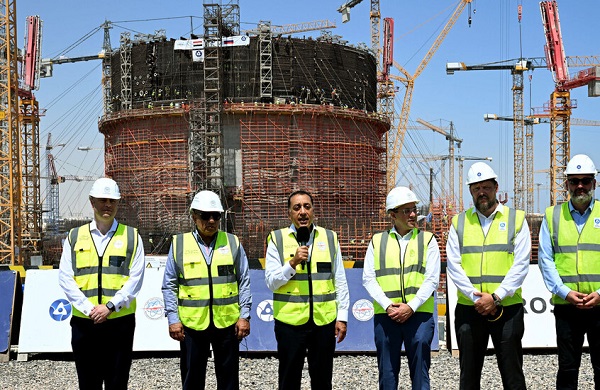
Egypt Daily News – Egypt has officially announced that its first nuclear power plant, currently under construction in El-Dabaa, will begin initial operations by mid-2028. Prime Minister Mostafa Madbouly made the announcement during a visit to the plant’s construction site, underscoring the government’s commitment to advancing this major national infrastructure project.
In a press conference held at the site, Madbouly stated that all phases of the project are currently underway. According to the latest timeline, the first of four nuclear reactors will be completed and enter preliminary operation in the second half of 2028. The remaining three reactors are expected to follow in 2029. This schedule aligns with recent discussions between President Abdel Fattah El-Sisi and the leadership of the Russian state-owned company overseeing the construction.
“This project remained an idea on paper for decades,” said the Prime Minister. “It was only through the determination of the political leadership and President El-Sisi’s unwavering commitment that this dream began to materialize. The project formally began in 2015 with the signing of the initial agreement and moved into the implementation phase by December 2017.”
The El-Dabaa Nuclear Power Plant, located on Egypt’s Mediterranean coast, symbolizes a long-held national aspiration dating back to the mid-20th century. Madbouly emphasized that the facility reflects Egypt’s ambition to acquire advanced technology in the field of peaceful nuclear energy, and it stands as a testament to the strategic partnership between Egypt and Russia in energy and technology development.
During the visit, attendees watched a documentary titled “The Features of the El-Dabaa Project”, which detailed the milestones reached so far. Madbouly also received a comprehensive briefing from Dr. Shereef Helmy, Chairman of the Nuclear Power Plants Authority, outlining the current status of the project and upcoming implementation steps.
The Prime Minister toured several critical areas of the site, including construction bases and technical workshops. These facilities are responsible for fabricating essential reactor components, such as the inner containment vessel, one of the most crucial safety elements in any nuclear reactor. He also inspected ongoing work at the plant’s second nuclear unit.
Dr. Helmy confirmed that the project is progressing steadily in line with the approved schedule, maintaining strict adherence to international standards of nuclear safety and quality assurance. He noted that Egyptian participation in the workforce has reached approximately 80%, and local companies are contributing to the manufacturing of certain plant components, a significant boost to domestic industry and technical capability.
Minister of Electricity and Renewable Energy Mahmoud Esmat, who accompanied the Prime Minister, highlighted that the El-Dabaa project is part of Egypt’s broader strategy to diversify its energy mix and meet growing electricity demand. “This station will be a cornerstone in Egypt’s sustainable development goals and part of its Vision 2030,” Esmat said. “It will mark a turning point in our peaceful use of nuclear energy.”
At the conclusion of the visit, Madbouly posed for commemorative photos with Egyptian and Russian engineers and workers at the site. He expressed his appreciation for their dedication and emphasized the importance of their efforts in realizing one of Egypt’s most ambitious energy projects.
The visit was attended by several senior officials, including Finance Minister Ahmed Kouchouk, Electricity Minister Mahmoud Esmat, and Dr. Shereef Helmy. From the Russian side, attendees included Karen Vassilyan, the Russian Consul General in Alexandria, and Alexey Kononenko, Deputy Head of Atomstroyexport, the general contractor for the project.
Once completed, the El-Dabaa Nuclear Power Plant is expected to play a transformative role in Egypt’s energy sector, positioning the country as a regional leader in nuclear energy and advancing its long-term goals of sustainable development and technological independence.
