

Ahmed Kamel – Egypt Daily News
Archaeologists working in the submerged harbor of ancient Alexandria have uncovered a rare and remarkably preserved pleasure vessel, a type of luxurious barge long described in classical texts but never before found in Egypt. The discovery, made near the sunken island of Antirhodos, has been hailed as a breakthrough in the study of early Roman Egypt and its opulent waterborne culture.
The wreck was located only seven meters below the surface and partially buried in sediment inside what was once Alexandria’s Portus Magnus. Built in the first half of the first century AD, the boat measured roughly 35 meters long and about 7 meters wide, with a flat-bottomed hull, a rounded stern, and a sharply angled bow suited for navigating calm, shallow waters rather than the open Mediterranean. Archaeologists believe it was powered entirely by oars and required more than 20 rowers to maneuver.
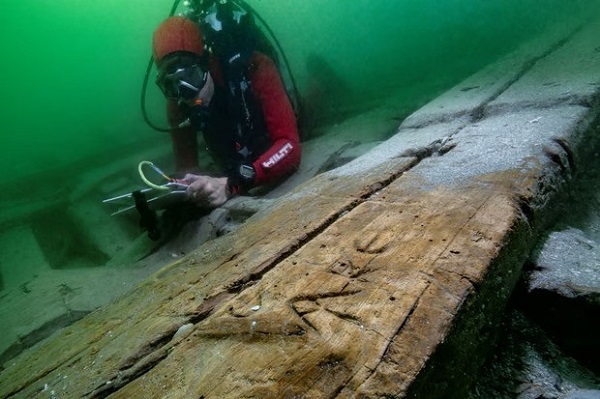
The vessel’s architecture was designed to maximize interior width, allowing for a central pavilion and an elaborately decorated cabin, features consistent with the grand pleasure craft described by ancient writers. Greek graffiti carved into the ship’s central carling supports the dating and suggests the vessel was built locally in Alexandria, a cosmopolitan port founded by Alexander the Great in 331 BC and famed for its monumental palaces, its temples, and the towering Pharos lighthouse.
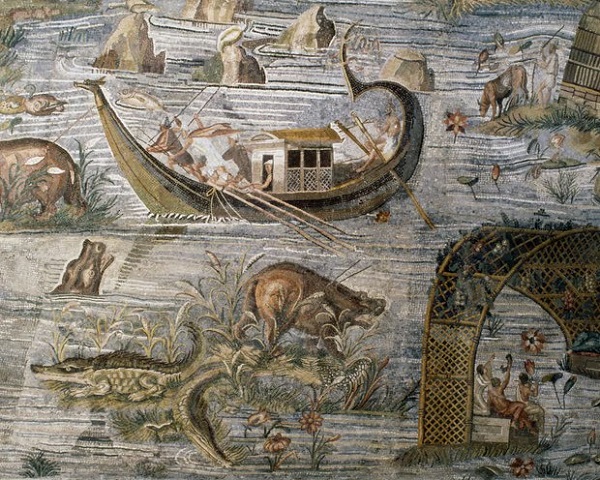
The discovery matches in striking detail the account of the Greek geographer Strabo, who visited Alexandria around 29–25 BC. He wrote of lavish cabin-boats used by royalty and revelers alike, vessels that glided along vegetated canals and served as venues for music, dancing, and unrestrained night-time festivities. Such boats also appear in ancient art, including the Nile mosaic of Palestrina, where noblemen hunt from smaller but stylistically similar craft. Until now, however, no archaeological example of such a vessel had ever been recovered.
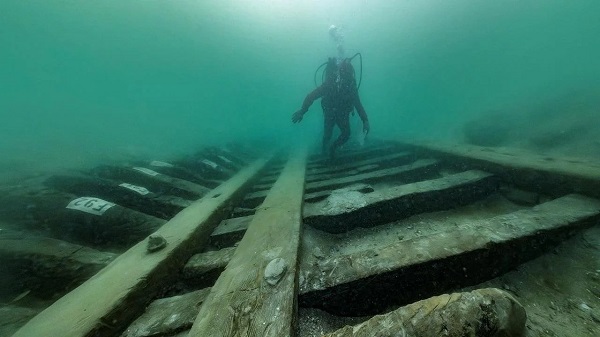
The find was made by the European Institute for Underwater Archaeology (IEASM) under the direction of Franck Goddio, who has led major underwater excavations in Egypt since the early 1990s. Goddio initially believed that two vessels were lying atop one another, so unusual was the boat’s construction. Its proportions and shallow-water design suggest it may have been used for leisurely excursions along the Nile delta waterways or for ceremonial functions connected to nearby temples.
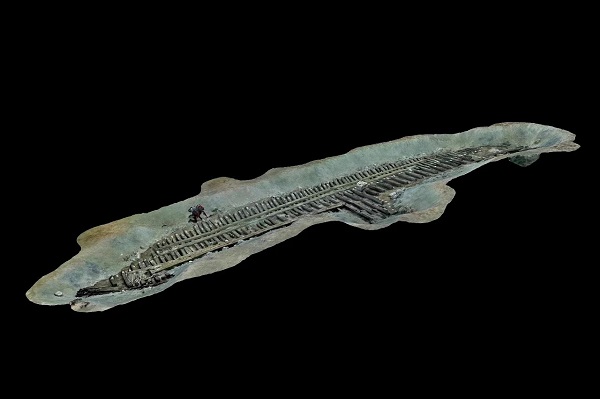
The wreck lies less than 50 meters from the site of the Temple of Isis on Antirhodos, which Goddio and his team have been excavating for decades. Based on its location, the archaeologists propose two theories. One holds that the boat sank during the catastrophic collapse of Alexandria’s shoreline around AD 50, when a series of earthquakes and tidal waves caused portions of the city including palaces, quays, and the Temple of Isis to slide beneath the sea. The second possibility is that the vessel was tied to the temple itself, serving as a sacred barge in the navigium Isidis, a yearly procession in which a richly adorned boat symbolized the solar journey of the goddess Isis, mistress of the sea and protector of sailors.
The newly uncovered ship joins a growing list of spectacular finds in Alexandria’s waters. Since the rediscovery of the island of Antirhodos in 1996, divers have retrieved statues, coins, ritual objects, and architectural fragments, many now on display at the Greco-Roman Museum in Alexandria. Elsewhere in the bay, archaeologists have uncovered remnants of the ancient city of Canopus and, in deeper waters, ships lost in the 1798 Battle of the Nile. Earlier this year, another remarkably preserved small boat was found in Alexandria’s eastern harbor, further underscoring the city’s long maritime history.
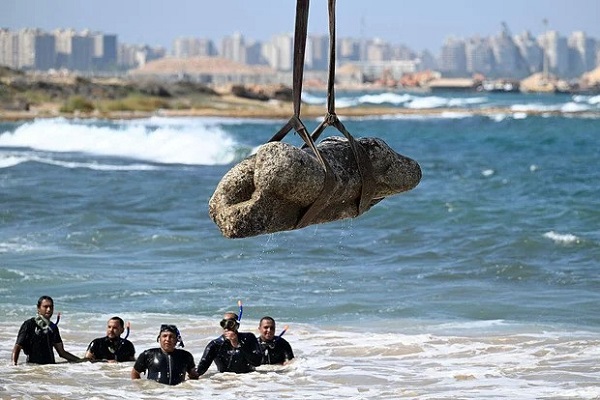
The discovery of the pleasure vessel also deepens contemporary concerns: modern Alexandria is sinking by more than three millimeters a year, and rising sea levels threaten to submerge a third of the city by 2050, even under optimistic climate projections. Its ancient ruins, once destroyed by natural forces, now face a slow repetition of history.
For now, the newly found barge will remain on the seabed in accordance with UNESCO guidelines, which recommend that underwater heritage be left in situ for long-term preservation. Research has only begun, but archaeologists expect the wreck to offer unprecedented insights into ritual practice, elite leisure, and daily life in one of the ancient world’s greatest cities.
According to the IEASM, the vessel opens a rare window into the wealth, religious symbolism, and aquatic pleasures of Roman-era Alexandria, a vivid reminder that the city, even at its height, was defined as much by its waterways as by its marble avenues and legendary libraries. Excavations will continue in the coming months, with experts hopeful that more discoveries lie buried beneath the shifting sands of the harbor floor.
