


Ahmed Kamel – Egypt Daily News
A highly anticipated summit between U.S. President Donald Trump and Russian President Vladimir Putin concluded Friday without the breakthrough many had hoped for: a ceasefire in the ongoing Russia-Ukraine war. Despite the carefully orchestrated optics and both leaders’ insistence that “progress” had been made, the summit ended with no formal agreement and Ukraine’s President Volodymyr Zelenskyy notably absent from the discussions.
The meeting, held at Joint Base Elmendorf-Richardson in Anchorage, marked the first direct encounter between Trump and Putin since Trump’s return to the presidency. It also represented the first face-to-face engagement between the U.S. and Russian leaders since Moscow launched its full-scale invasion of Ukraine in 2022, a war that has left more than a million people dead or injured and devastated large swaths of eastern Ukraine.
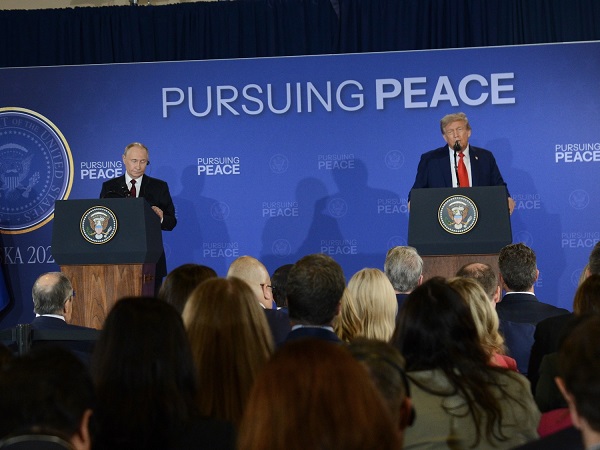
While standing before a backdrop emblazoned with the slogan “Pursuing Peace,” Trump told the assembled press that “great progress” had been made. Putin, speaking first, described the summit as “constructive” and claimed the two sides had reached an “understanding.” But neither leader provided specifics, and neither took questions from the hundreds of journalists present.
Instead, the event closed with a handshake and vague commitments leaving key stakeholders, particularly Ukraine and its European allies, grasping for clarity.
A Summit Without Ukraine
Notably absent from the summit was Ukrainian President Volodymyr Zelenskyy, who had not been invited. Trump said he planned to call Zelenskyy after the meeting to brief him on the talks. In a post-summit interview with Fox News host Sean Hannity, Trump elaborated little but hinted that future negotiations would depend heavily on Zelenskyy’s willingness to compromise.
“A lot of points were agreed on,” Trump said. “But there’s one or two pretty significant items. I think they can be reached. It’s really up to President Zelenskyy now to get it done.”
Trump, who had promised during his campaign to end the war within 24 hours of taking office, acknowledged the complexity of the conflict and floated the idea of a second, trilateral meeting involving himself, Putin, and Zelenskyy though he offered no timeline or details.
Asked what advice he gave the Ukrainian president during their phone call, Trump was blunt: “Make the deal,” adding, “Russia is a very big power, and they’re not,” referring to Ukraine.
Zelenskyy, for his part, had expressed cautious hope ahead of the meeting, calling for a “just peace” and reiterating Ukraine’s demand that any resolution respect its territorial integrity. Kyiv has consistently ruled out surrendering territory to Russia particularly the regions illegally annexed by Moscow and has pushed for a U.S.-backed security guarantee.
In the hours following the summit, Ukrainian lawmaker Oleksiy Honcharenko expressed skepticism about the outcome. “It seems Putin has bought himself more time. No ceasefire or de-escalation has been agreed upon,” he wrote on Telegram.
Optics and Symbolism
Though no agreements were signed, the summit was rich in symbolism. Upon Putin’s arrival in Alaska, a red carpet was rolled out, and U.S. military jets flew overhead in a show of diplomatic theater. At one point, Putin laid flowers at a memorial cemetery for Soviet soldiers a gesture widely seen as an attempt to humanize Russia’s role in global conflicts.
Trump and Putin presented a united front in their closing remarks, with Putin even suggesting their next meeting take place in Moscow. “Next time in Moscow,” he said in English. Trump chuckled and replied, “That’s an interesting one. I could see it possibly happening.”
The optics of the summit a cordial, statesmanlike meeting between leaders of nuclear powers offered a stark contrast to the ongoing bloodshed in Ukraine, where air raid sirens continued to blare across eastern regions even as the summit took place. Russian border regions also reported fresh Ukrainian drone attacks during the talks.
The summit came amid renewed scrutiny over Putin’s international status. The Russian leader is currently wanted by the International Criminal Court for alleged war crimes, specifically the forced deportation of Ukrainian children. Russia denies the allegations and has rejected the legitimacy of the court. Neither Russia nor the United States are parties to the ICC.
No Clear Path Forward
While Trump has dangled the threat of new sanctions including punitive tariffs on nations buying Russian oil, he indicated Friday that those measures are now on hold. “Because of what happened today, I think I don’t have to think about that now,” Trump told Hannity. “I may have to think about it in two or three weeks.”
Trump has also threatened to impose tariffs on India and China, both major buyers of Russian crude, though it’s unclear whether such steps are intended as negotiation leverage or policy goals.
Putin, meanwhile, reiterated longstanding Russian positions, asserting that peace is possible only if the “root causes” of the war, a term often used by Moscow to reference NATO expansion and Ukrainian aspirations for Western alignment are addressed. He did not mention any willingness to meet with Zelenskyy or to halt military operations.
The Russian president did, however, allude to possible progress on other fronts, including a future nuclear arms control agreement, something Trump has previously expressed interest in. But the topic was not confirmed to have been discussed at the Alaska summit.
Allies on Edge
European leaders and NATO officials, many of whom were not consulted before the summit, are watching developments with growing concern. There is lingering fear that Trump, who has previously questioned the value of NATO and expressed admiration for authoritarian leaders, might accept a “frozen conflict” in Ukraine that tacitly legitimizes Russian control over occupied territories.
For now, Trump insists he is not negotiating on Ukraine’s behalf. “I’m not here to negotiate for Ukraine. I’m here to get them at a table,” he said prior to the summit.
Still, his posture has done little to reassure allies who fear that Ukraine may be pushed toward a compromise that sacrifices long-term sovereignty for short-term peace.
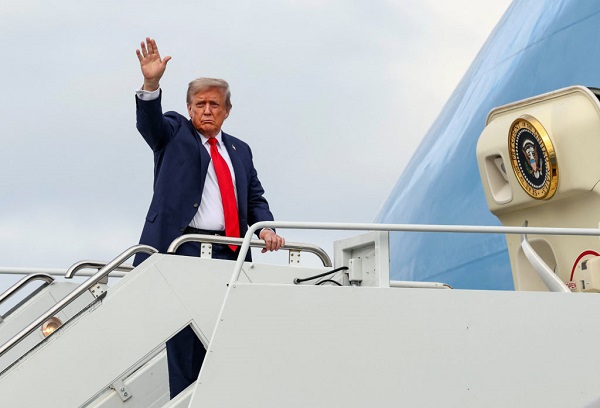
As Trump boarded Air Force One and departed Anchorage for Washington, he struck an optimistic tone. “We’ll speak to you very soon and probably see you again very soon,” he told Putin.
But for Ukrainians and their allies, the message was less clear and the path to peace no closer than before.
