

Ahmed Kamel – Egypt Daily News
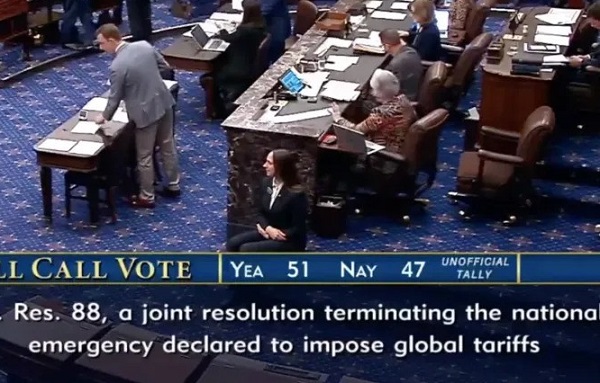
In a historic 51–47 vote, the U.S. Senate has voted to revoke President Donald Trump’s emergency authority to impose tariffs on foreign goods, delivering a rare bipartisan challenge to one of the cornerstones of his economic policy.
The resolution, which seeks to terminate Trump’s 2023 national emergency declaration under the International Emergency Economic Powers Act (IEEPA), marks one of the most significant congressional efforts in years to reclaim legislative control over U.S. trade policy.
The measure passed with the support of four Republican senators Susan Collins of Maine, Mitch McConnell of Kentucky, Rand Paul of Kentucky, and Lisa Murkowski of Alaska joining all Democrats in favor. Though the resolution faces steep odds in the Republican-controlled House and is almost certain to be vetoed by the president, it represents a striking act of defiance from lawmakers increasingly uneasy with Trump’s expansive use of executive authority.
Reasserting Congressional Oversight
At the heart of the dispute is Trump’s decision to use emergency powers to justify sweeping tariffs on imports from more than 100 countries, including key allies such as Canada, Japan, and the European Union. He has argued that the tariffs are necessary to protect American industry and national security, citing the U.S. trade deficit and reliance on foreign manufacturing as economic threats.
But critics say the policy has morphed into an unchecked tool of economic nationalism one that has strained diplomatic relationships, disrupted supply chains, and driven up costs for American consumers.
“The Constitution gives Congress, not the president, the power to regulate trade,” said Senator Ron Wyden (D–Ore.), chair of the Senate Finance Committee, who introduced the measure. “American families are being squeezed by higher prices on everything from cars to canned goods. It’s time for Congress to take back its authority.”
Republican Defections Underscore Unease
The defection of several prominent Republicans underscored growing unease within the president’s own party. Senator Collins said the tariffs had damaged Maine’s close trading ties with Canada, its largest international partner.
“The Maine economy is integrated with Canada, our most important trading partner,” she said. “Trade policy should reflect cooperation, not confrontation.”
McConnell’s vote in favor of the measure was particularly notable, reflecting discomfort even among GOP leadership over Trump’s sweeping use of emergency powers. Murkowski and Paul, long advocates for limiting executive authority, framed their votes as a matter of constitutional principle rather than political opposition.
Courts and Lawmakers Push Back
The Senate’s action follows an August 2025 federal appeals court ruling that found Trump likely exceeded his authority under IEEPA when he imposed certain tariffs without congressional approval. The court wrote that it was “unlikely that Congress intended the President to have unlimited tariff authority,” setting an important legal precedent that lawmakers have now sought to reinforce through legislation.
Earlier this year, a bipartisan group of senators introduced a separate bill that would require congressional approval within 60 days of any new presidential tariff declaration, effectively creating a check on executive trade actions going forward.
The Economic Impact
Economists say Trump’s tariffs have functioned as a hidden tax on consumers and businesses. The nonpartisan Tax Foundation estimates that the measures have cost the average U.S. household more than $1,600 annually, while potentially reducing overall GDP by half a percentage point over the next decade.
Since the tariffs took effect, the U.S. government has collected roughly $88 billion in additional customs revenue—money that critics say came largely from American importers and, by extension, consumers.
For many industries, the impact has been deeply personal. Nebraska soybean farmer Mary Jensen told the Associated Press that the constant uncertainty over trade rules has made it nearly impossible to plan. “You plant your crop in the spring, you don’t plant it on promises that change in a weekend,” she said.
In Maine, loggers and paper mill workers have voiced similar concerns about tariffs on Canadian lumber and pulp key exports that sustain the state’s rural economy. “People are worried about layoffs and losing markets we’ve built for decades,” Collins said.
Symbolic but Significant
While the Senate’s resolution may ultimately fall short of becoming law, analysts say it carries significant symbolic weight. It signals a growing bipartisan appetite in Congress to rein in presidential power after years of executive expansion across multiple administrations.
“This isn’t just about trade it’s about the balance of power,” said Wendy Cutler, a former U.S. trade negotiator now with the Asia Society Policy Institute. “Congress is reasserting its constitutional role, and that’s a message presidents of both parties should take seriously.”
The White House, meanwhile, has dismissed the vote as “political theater.” In a statement, press secretary Steven Cheung said the president “remains committed to defending American jobs and industries against unfair foreign trade practices,” and vowed to veto the measure if it reaches his desk.
For now, the Senate’s action stands as a rare bipartisan rebuke of Trump’s economic agenda and a reminder that, even in an era of deep political division, Congress still retains tools to challenge the executive branch when it chooses to use them.
