

Ahmed Kamel – Egypt Daily News
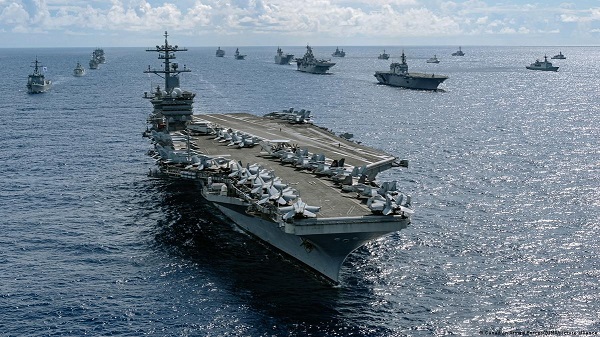
A U.S. naval blockade on Iran has officially entered into force after an order from President Donald Trump, escalating tensions in the Gulf and triggering immediate concerns over global energy stability and maritime security.
The move authorizes U.S. forces to intercept all vessels entering or leaving Iranian ports, with operations focused on the Strait of Hormuz, the Gulf of Oman, and surrounding international waters.
Full Maritime Interception Order Activated
The decision follows the collapse of talks between Washington and Tehran in Islamabad, after which Trump announced via Truth Social that the U.S. Navy would begin “immediate enforcement” of a maritime blockade.
He warned that any vessel linked to Iranian port fees or shipping arrangements would be stopped, stating that no ship “will enjoy safe passage if it violates U.S. directives in international waters.”
U.S. Central Command confirmed that enforcement began at 10:00 a.m. Eastern Time on Monday, stating that all maritime traffic to and from Iranian ports would be subject to interception, diversion, or capture.
Strategy Aimed at Economic Pressure
From a U.S. strategic perspective, the blockade is designed to significantly weaken Iran’s economy by restricting oil exports and disrupting maritime logistics.
Analysts describe the move as an escalation intended to increase pressure on Tehran and force a rapid return to negotiations by targeting one of Iran’s most critical revenue channels.
Trump also indicated that any vessel that has paid transit-related fees to Iran could be targeted, including ships already in international waters.
Iran Rejects Blockade as “Unenforceable”
Iranian officials dismissed the blockade as ineffective and politically motivated.
Ali Reza Zakani, a senior adviser to Iran’s leadership, said the country would not be pressured by maritime restrictions, claiming Iran has “strategic capabilities that have not yet been deployed.”
He added that attempts to enforce a blockade in the Gulf would fail, calling the policy “detached from operational reality.”
Global Economic Shock and Oil Price Surge
Markets reacted sharply to the announcement.
Crude oil prices jumped nearly 9%, with Brent trading close to $104 per barrel, while European natural gas prices surged by 18% amid fears of supply disruption.
Economists warn that any prolonged disruption in the Strait of Hormuz could severely impact global energy markets, as nearly one-fifth of the world’s oil passes through the chokepoint.
Warnings of Global Recession Risk
Financial analysts have cautioned that a sustained maritime crisis could trigger widespread inflation, supply chain disruption, and a slowdown in global growth.
The Strait of Hormuz is considered one of the most critical energy corridors in the world, and even limited disruption has historically caused sharp price volatility.
UK Refuses to Join US Blockade
International reaction has already begun to split.
British Prime Minister Keir Starmer reportedly rejected participation in the blockade, warning that escalation could worsen inflation pressures and increase fuel costs for households already facing economic strain.
