


Ahmed Kamel – Egypt Daily News
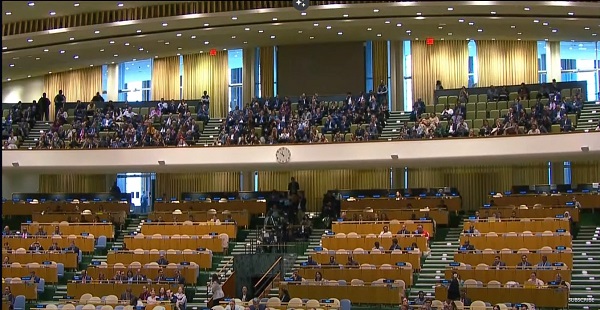
A number of United Nations member-state delegations staged a visible protest at the General Assembly on Thursday, walking out of the hall as Israeli Prime Minister Benjamin Netanyahu began his address. Rows of noticeably empty seats underscored the delegations’ rejection of Israel’s conduct toward the Palestinians, according to observers in the chamber.
The presiding officer called for order and appealed to delegates to remain in the room, but the departures continued as Netanyahu spoke, turning the prime minister’s appearance into a highly polarized moment at the world body.
Netanyahu Frames Speech Around Security Threats and Hostages
In a forceful address, Netanyahu framed Israel’s actions as defensive responses to threats he said emanate from Iran and its regional allies. He asserted that Iran “threatens Israel and the United States,” thanked former U.S. President Donald Trump for unspecified measures, and said Israeli forces had “destroyed programs and weapons” he attributed to Iran. He also claimed, without independent corroboration in the speech, that Israel had “eliminated half of the Houthi leadership in Yemen” and “controlled the skies over Iran in a 12‑day war.”
Netanyahu called for the elimination of Iran’s stockpile of enriched uranium and vowed that Israel would not allow Tehran to rebuild a nuclear capability.
Turning to Gaza, the prime minister said the war there “can end immediately” if all hostages are returned and Hamas is disarmed. Addressing the hostages directly he said he was speaking to them “from this hall” Netanyahu vowed that Israel would not rest until every captive was returned “alive or as martyrs,” and demanded that Hamas release detainees now, warning that failure to do so would bring continued Israeli pursuit.
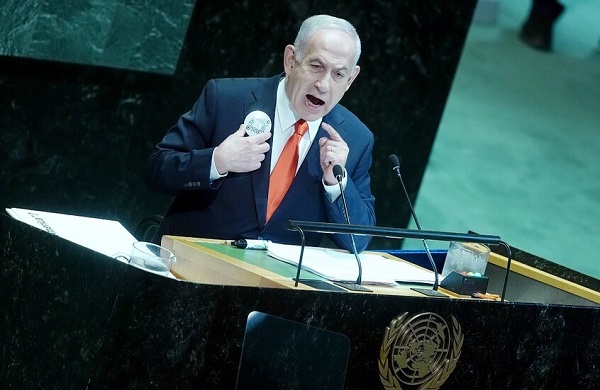
Israeli prime minister Benjamin Netanyahu forcefully rejected the idea of a Palestinian state during his address to the United Nations General Assembly, calling the recent wave of recognitions “shameful and utterly mad.” He warned that the decisions to recognize a Palestinian state would encourage attacks “against Jews and innocents everywhere” and said those who voted for such measures would carry a stain of shame.
Netanyahu framed the moves as a dangerous reward to extremists, equating the timing and proximity of a potential Palestinian state to Jerusalem with giving a terrorist group territory near a major capital. “Granting the Palestinians a state a mile from Jerusalem after October 7 is like giving al‑Qaeda a state a mile from New York after September 11,” he said.
Reiterating Israel’s firm opposition, Netanyahu pledged that his government would not allow what he described as “the imposition of a terrorist state” on Israel. “Israel will not commit national suicide because you lack the courage to confront hostile media and antisemitic mobs calling for Israel’s blood,” he declared, framing the issue as an existential threat rather than a diplomatic dispute.
Unprecedented Claim: Phones and Broadcasts
In an unusual claim that drew attention in the Assembly, Netanyahu told delegates that the Israeli military had taken control of the mobile phones of Gaza residents and Hamas operatives, and that his speech was being broadcast through those devices. He presented the assertion as a direct message to people inside Gaza; it was described in real time by the Israeli press desk broadcasting the address.
Political and Moral Rhetoric
Netanyahu’s remarks combined security arguments with sweeping critiques of Palestinian leadership and Western diplomacy. He argued that past territorial concessions to Palestinians had been followed by renewed attacks on Israel and characterized the Gaza Strip as a “terror platform” used to launch the October 7 attacks. He also rejected the idea that Palestinian aspirations necessarily entail a two‑state outcome alongside Israel, saying opponents sought a state “in place of Israel.”
Addressing countries that recognize a Palestinian state, Netanyahu said Israel would not be “muzzled” by such moves and insisted that Western leaders had “yielded under pressure,” vowing that Israel would not do the same.
Walkouts as Diplomatic Protest
Delegations that left the chamber did so, officials said, to signal their opposition to Israel’s policies in the occupied Palestinian territories and to express solidarity with Palestinian civilians. Empty seats in the General Assembly have become a common diplomatic gesture when countries wish to register protest without staging walkouts that might dominate every session.
The walkouts came amid a sustained international debate over the conduct of the Gaza war, the scale of civilian suffering, and the appropriate balance between Israel’s security needs and humanitarian protections for civilians.
Wider Implications
Netanyahu’s address and the walkouts illustrate the deep polarization surrounding the Israel‑Gaza conflict on the world stage. For many delegations and observers, the departures were a rebuke of Israeli policy; for supporters of Israel, the speech reaffirmed security concerns and the demand for the return of hostages.
As the Assembly session proceeds, diplomats and capitals will be watching for whether the speech shifts votes, resolutions, or diplomatic alignments and whether the episode further hardens divisions within the United Nations over how to respond to the conflict and its humanitarian consequences.
